Strong-Motion Database
Explore the digital acceleration records collected throughout Costa Rica for academic and research purposes.
Explore database
LIS · University of Costa Rica
Open strong-motion records and station information from the Earthquake Engineering Laboratory of the University of Costa Rica.
Open scientific resources
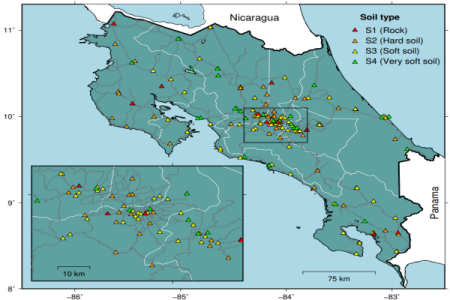
Access the records or consult the network of stations and their soil classification.
Explore the digital acceleration records collected throughout Costa Rica for academic and research purposes.
Explore databaseConsult station locations, geographic coverage and the soil classification available for each site.
View stationsAbout the network
The Earthquake Engineering Laboratory at the University of Costa Rica (LIS-UCR for its acronym in Spanish) started operations in 1983. That year, the United States Agency for International Development (USAID) donated several SMA-1 Kinemetrics strong-motion accelerographs to Costa Rica. They were located along the Pacific coast and the highly populated Central Valley. That was known as the Faculty of Engineering's Accelerographic Network. It was an analog network, which meant that after a strong earthquake took place, the collection and processing of the information took several days to weeks to get ready for analysis.
In 1989 the name was changed to LIS-UCR. New digital instruments were acquired and the geographic coverage of the stations increased. At the time of writing this document, LIS-UCR has more than 160 digital, 24-bit strong-motion units located in free-field conditions, boreholes and inside buildings. LIS-UCR is in charge of recording, processing and storing all acceleration records for academic and research purposes.
Database growth
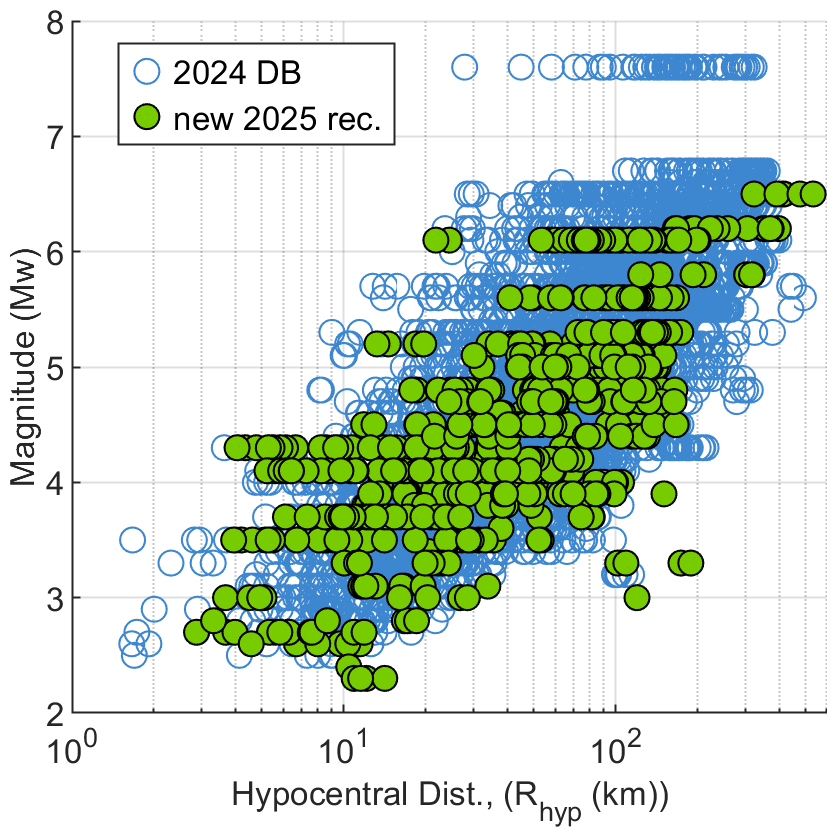
The time span for the database provided on this page ranges from 1998 to the present.
| Year | New records | Earthquakes | Magnitude (Mw) |
|---|---|---|---|
| 2025 | 887 | 90 | 2.4–5.2 |
| 2024 | 717 | 130 | 2.6–6.2 |
| 2023 | 1,217 | 208 | 2.5–6.7 |
| 2021 | 685 | 148 | 2.6–6.7 |
| 2020 | 1,043 | 190 | 2.5–6.0 |
Methodological note. From 2020, records of earthquakes of moderate to low magnitude with sensitive acceleration values for the population are included in the database, even if the automatic system has not been triggered. Therefore, the number of records increased significantly.